I still remember her face at Washington Square Diner.
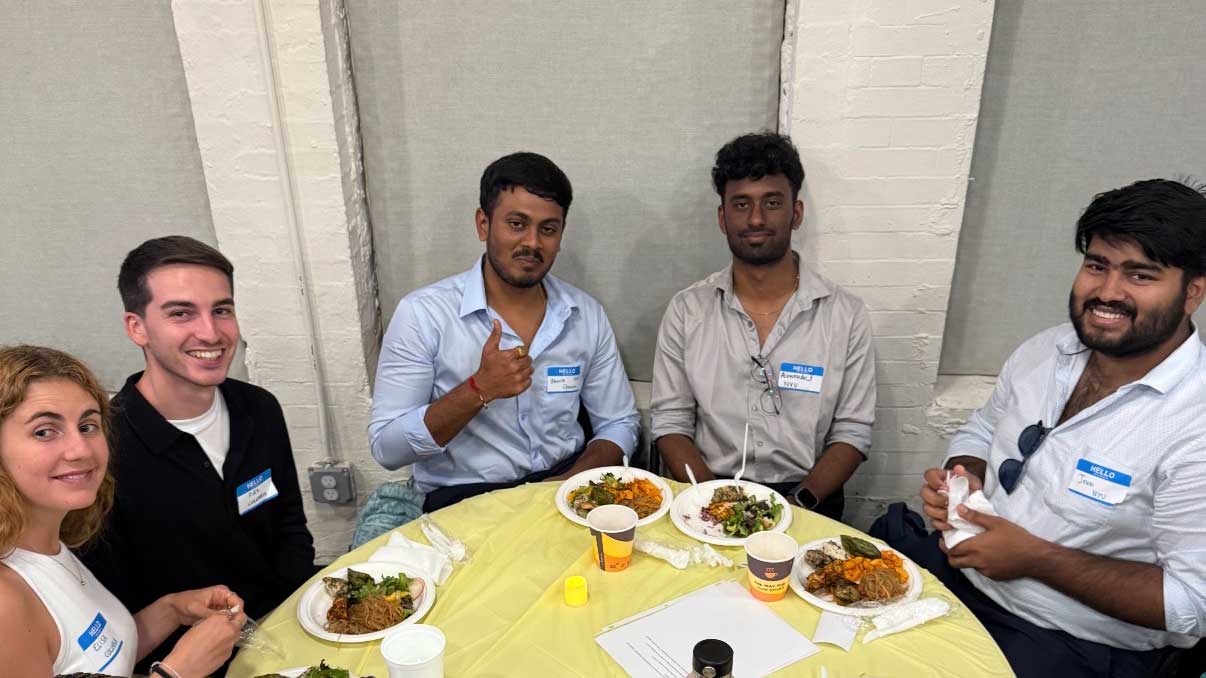
We were sharing a meal with a small group of international students from NYU. Around the table were students from Iran, India, China, and Bangladesh. Different countries. Different cultures. Different stories. Different religious backgrounds. All of us gathered in a diner near Washington Square Park, eating together while I was beginning to realize that the nations were not only somewhere across the ocean. They were sitting across the table.
One of the students, a young woman from Iran, began telling me about her faith in Jesus. She was joyful as she talked about how she had come to believe in Him.
She told me about a vivid dream she had. In the dream, she was underwater and unable to breathe. She was drowning. Then Jesus spoke to her. She followed His voice, and she was rescued.
That dream became one of the ways God drew her heart to faith in Christ.
As she told the story, she was not timid or ashamed. She was radiant. She was free. She could breathe. She had life. She had Jesus. There was joy in her face as she described the One who had rescued her.
Later in the conversation, she mentioned her family.
So I asked, “How have they taken the news?”
Immediately, tears welled up in her eyes.
She controlled herself and kept from crying fully, but her cheek began to shake and her voice trembled. With visible grief, she told me, “My father told me to never come home again.”
There are moments in ministry when something moves from your head to your heart. You may already believe something is true, but then a person’s story makes you feel the weight of it. That was one of those moments for me.
I have preached about the cost of following Jesus. I have read the words of Jesus about taking up our cross. I have encouraged people to be bold in their faith. But sitting in that diner across from this young woman, I saw the cost of discipleship through tear-filled eyes.
This was not someone being mocked for her faith. This was not someone being unfollowed on social media. This was not mild awkwardness at a family dinner. This was a young woman who had followed Jesus and experienced the severing of ties with the people who had given her life, raised her, and loved her.
In that moment, international student ministry stopped being a strategy for me.
It became holy ground.
My name is Daniel McGhee. I serve as the New England Collegiate Director for the Baptist Churches of New England and as the New York City Area Director for International Students, Inc. My wife, Kari, and I also serve at NYU as Spiritual Life Advisors, similar to a chaplain role. That means we are able to go on campus, meet with students, build relationships, and be available to students in an ongoing way.
We have been planting churches in New York City since 2011, but somewhere along the way God began moving our hearts toward the nations in a way we had not seriously considered before.
Not nations in the abstract. Not nations as a missions slogan. Nations with names, faces, stories, accents, fears, questions, grief, joy, and dinner invitations.
International students.
For years, I thought about missions mostly in terms of going. Go across the ocean. Go to another country. Go learn another culture. Go share the gospel somewhere far away. And, of course, that call remains beautiful and biblical. But international student ministry has reminded me that sometimes the nations arrive at the airport, move into a dorm, sit in a classroom, and wonder if anyone in this country will ever learn their name.
International students are some of the clearest examples of people Christians have an opportunity to bless. Many move here from countries where they were part of the majority culture, majority ethnicity, and majority language. Then they arrive in a city or on a college campus where suddenly they are the minority in language, culture, customs, food, humor, holidays, assumptions, and even basic systems of daily life.
They are far from family. Far from the food that tastes like home. Far from the people who know their story. Far from the rhythms that once made life feel familiar.
And many of them are young adults in that complicated space between adolescence and adulthood, asking the questions all college students ask: Who am I? What do I believe? What kind of life am I building? Who can I trust? Where do I belong?
But international students carry all of those questions in a foreign land.
They face the normal pressures of college, but with added layers of loneliness, language barriers, visa concerns, financial pressure, and family expectations from across the world. Many are brilliant and courageous. Many will become leaders in their fields. But they are also young adults far from home, trying to figure out who they can trust.
That is one reason Christian hospitality matters so much.
Hospitality is not just being nice. It can become a form of stability, safety, friendship, and gospel witness. It says, “You are not invisible here. You are not just a student ID number. You are not merely a visitor in our country. You are a person made in the image of God, and there is a place for you at our table.”
The opportunity is massive. According to Open Doors 2025, U.S. colleges and universities hosted 1,177,766 international students during the 2024–2025 academic year. NYU alone reported 27,532 international students in 2024–2025. I had heard that number before and honestly thought it sounded made up until the university confirmed it. There are more international students at NYU than there are people in many entire towns in my home state of Arkansas. In New England, the need and opportunity are also enormous. Massachusetts alone has more than 82,000 international students, giving it one of the largest international student populations in the country.
But the numbers are not the point.
The numbers simply tell us how many stories are walking around our campuses.
One of the ways we have seen this need up close is through Connect NYC, a dinner we host collaboratively with four other international student ministries in New York City. The purpose is simple: create a special meal and a fun, welcoming night designed only for international students.
At Connect NYC, students share dinner around round tables. They play icebreaker games and get to meet one another. The highlight of the night is a 10- to 15-minute TED Talk-style presentation designed to capture students’ attention and connect with where they are in this season of life. The topics are thoughtful, relevant, and always spiritual. They speak to things like adjusting to a new culture, navigating change, finding belonging, making wise choices, and considering how the decisions we make in this season can shape the rest of our lives.
After the talk, each table has a facilitator who helps guide the conversation. The goal is not to pressure students, but to create space where they can talk honestly, ask good questions, hear from one another, and consider deeper spiritual realities.
It is designed for community. It is designed so students do not have to remain lonely or isolated. It is designed to help them find a place where they are seen, welcomed, and invited into meaningful conversation.
At one of our first Connect NYC dinners of the semester, a young woman from China named Mei came for the first time. She enjoyed it so much that she came back the next week.
At an event with 60 to 80 students, it can be hard to remember every name. I was in work mode that night, trying to make sure everything was moving, people were welcomed, details were handled, and conversations were happening. Sometimes ministry can start to feel like work, even when the work is good.
Then Mei walked up to me with a huge smile and said, “Hi, Daniel! It’s so good to be back!”
In that moment, God slowed me down.
I had to glance at her name tag to remember her name, but she remembered mine. More than that, she was happy to be back. She was happy to see me and Kari. She was happy to return to a place where she had felt welcomed.
And suddenly, the event was not just an event anymore. It was not just logistics, tables, food, games, and discussion questions. It was Mei, far from home, finding a place where she could belong.
I shared that moment of joy with her, because I really was glad she was back too.
That is what international student ministry often looks like. Sometimes it is a life-changing conversation in a diner. Sometimes it is Mei returning to dinner with joy because someone welcomed her and gave her a place to come back to.
Those two moments have stayed with me.
One student from Iran, joyful in Jesus and grieving what it cost her.
One student from China, smiling because she had found a place where she wanted to return.
Both reminded me that international student ministry is not theoretical. It is deeply personal. It is not first about programs, platforms, or strategies. Those things matter, but they are not the heart of it. The heart of it is a student sitting across the table. A student remembering your name. A student wondering whether they belong. A student asking spiritual questions. A student far from home who may be more open to friendship, faith, and family than we realize.
Behind every statistic is someone learning how to navigate a grocery store, understand a classroom discussion, read a lease, find a doctor, make friends, and decide what they believe about God. Behind every statistic is someone who may spend Thanksgiving alone unless someone invites them in. Behind every statistic is someone who may be curious about Jesus but has never had a Christian friend they trusted enough to ask.
One of the simplest and most powerful ways we can love international students is through hospitality.
And hospitality does not have to be complicated.
Invite students to dinner. Pick them up from the airport. Help them understand public transportation. Explain how tipping works. Invite them to your church. Take them apple picking. Include them in a Thanksgiving meal. Give them somewhere to go during Christmas break when the dorm feels empty and flights home are too expensive. Ask them about their family, their country, their fears, their hopes, their studies, and their faith.
But hospitality is not a one-way street.
One of the most meaningful ways to welcome international students is not only to cook for them, but to invite them to cook for you. Ask them to make the comfort food they miss from home. Let them teach you about the spices, the smells, the stories, the holidays, and the family memories connected to that meal.
Sit in your own kitchen as the learner.
Ask questions. Listen. Laugh. Let them explain what their mother or grandmother used to make, what food they ate during celebrations, and what tastes like home when home feels far away.
In those moments, students are not simply receiving hospitality; they are offering it. They are sharing dignity, culture, memory, and love. The table becomes more than a place to feed someone. It becomes a place where friendship grows and the image of God in every culture is honored.
This matters because international student ministry is not about making people our projects. It is about becoming friends. It is about seeing people as God sees them. It is about recognizing that the Great Commission is not only fulfilled through platforms and programs, but also through ordinary Christians opening ordinary homes and making room at ordinary tables.
Many of us pray for the nations. That is good. We give so missionaries can go to the nations. That is good. We send teams across the world. That is good.
But what if, in addition to going to the nations, we also recognized that God has brought the nations near?
What if every Baptist collegiate ministry saw international students as part of its mission field?
What if every Baptist church near a campus asked, “Who is far from home, and how can we become family?”
What if Thanksgiving tables, airport pickups, coffee conversations, Bible studies, and home-cooked meals became small acts of gospel witness?
What if churches stopped waiting for a perfect program and simply started with a meal?
The first step does not have to be impressive. It may be as simple as learning the names of international students already connected to your campus. It may be partnering with an existing international student ministry. It may be asking your church members to host students during school breaks. It may be helping a student practice English. It may be inviting a student to share their story with your small group. It may be creating space for honest questions about Jesus.
International students do not need us to be experts in every culture. They need us to be humble, curious, generous, and faithful. They need people who will listen more than they lecture. They need people who will honor their family stories, even when those stories are complicated. They need people who will show the love of Christ before they try to explain everything about Christianity.
And some of them, like the young woman from Iran, are paying a price for following Jesus that should humble the rest of us.
I still think about her joy. I think about the way she described Jesus rescuing her. I think about the freedom on her face when she told me she could breathe. And I think about her tears when she told me what it cost.
I think about Mei, walking back into the room the next week, smiling because she had found a place where she was glad to return.
I think about how easy it would be for students like them to feel alone in this country, alone on campus, and alone in the deepest parts of their lives.
And I think about how powerful it is when the people of God become family.
That is what hospitality can do. That is what collegiate ministry can do. That is what local churches can do.
The nations are already here. They are studying on our campuses, walking through our cities, sitting in our classrooms, and wondering if anyone will welcome them.
May we be the kind of people who do.
May we see the students God has brought near.
May we open our homes, our tables, our calendars, and our hearts.
And may international students discover, through the love of Christ’s people, that even far from home, they are not forgotten by God.
Daniel McGhee is the NYC Area Director for International Students Inc. and the Protestant Spiritual Life Advisor for Global Spiritual Life, NYU. You can follow NYC International Students on Instagram @nycinternationalstudents and Daniel @danieltmcghee.