Making the Most of Your Summers

When I think of collegiate ministry, I equate the year-long experience to an incredible ride down the rapids of the middle section of the Ocoee River in southeast Tennessee.  The fall semester is the immediate launch into Class III rapids called “Grumpy.”  It is typical to be launched out of the boat with the only choice of riding the rapids with your body tucked and your feet in front of you until you reach the calm waters a few hundred yards downstream.  And this is just the beginning of an exhilarating ride of Class III and IV rapids for several hours.  In the fall semester, instead of several hours, we have several months of full days of ministering to a strategic group who desperately needs to hear the Gospel, to mature in their faith, and come to a place where they can reproduce the Gospel into others’ lives on campus and beyond.  By the end of the spring semester, you come to the end of an incredible journey where you are completely exhausted.  But, like any journey, you need a quiet season to recuperate, which is called summers for us.  What do you do to make the most of this slower season of ministry?

Here are a few suggestions I have learned from my years of serving as a campus-based minister:

1. Celebrate the “wins” from the school year.  How have you seen God move in the lives of your students and yourself? 

Someone came to faith in Christ… a young leader grew in their leadership skills… a student who has a deeper, consistent, and growing walk with Jesus… a disciple-making student who has made a difference in the lives of other students… a student who overcame his/her fear to share the Gospel for the first time… a student who took the plunge to spend his/her summer on mission for Christ… etc.  I make sure to share these God stories with our ministry supporters.

2. Rest…Play…Recalibrate. 

There is no way you and I can keep a year-round pace like we live in the fall and spring.  Soon after students have departed for the summer, take some time to rest your body, mind, and soul.  Then play! You need a hobby that recharges you.  For me, it is exercising and fishing.  Then, I learned this next idea from a fellow campus minister.  I take two consecutive weeks off without doing any ministry-related activities.  I will take a week to enjoy with my immediate family and a second week just to be at home or visiting extended family.  This allows me to recalibrate to a more normal pace.

3. When I am not doing #1 and #2 in May and June, I work on personal development and the BCM facility and grounds. 

I want the BCM to be a student-friendly, welcoming, and functional place of ministry.  There are some maintenance needs that are best done when students are not around.  Additionally, I focus some time on personal development through reading and listening to others who have a pulse on Next Generational ministry and trends.

4. July is my “framing” season. 

This is where I take the input from student leaders from the end of the spring semester and my evaluation of the previous year to begin developing a “frame” for what the upcoming school year needs to look like.  I am consistently evaluating and making adjustments to improve the quality of the ministry from year to year.  Much of my evaluation and framing is built around connecting with new students those first three weeks of the semester, most effective practices of evangelism and strategies of evangelism for students, fine-tuning our discipleship model, making plans to teach and mobilize students to live on mission for Christ through our mission partners, and best practices to partner with local churches in significant ministry opportunities.

5. August is equipping and empowering the students and local churches…

to engage the campus through ministry platforms which focus on evangelism and disciple-making to “people-groups” on campus.

I pray you have an incredible summer of being recharged!

Ben Maddox is the Campus Minister at TN Tech BCM in Cookeville, TN. You can follow him on Instagram @benmaddox98 and the ministry @tntechbcm.

Including My Family in Ministry

As a husband, father, and minister it is without question my family is my primary ministry calling. My wife and I are blessed with three children who are currently 22, 19, and 17. While I have always desired and prioritized my wife and children being involved in my ministry, each season has been different. The season we are currently in has been one of the most unique and challenging related to my family’s involvement in ministry. For most of our married life, my wife had part-time jobs and she ministered alongside me. She was the stereotypical minister’s wife who worked part-time plus for free. We wanted our children to minister with us teaching them how to serve others and live sacrificially. Now my wife has a full-time job and her availability is not the same. Our high school children have been busy with school, extracurricular activities, work, and hanging out with friends. Our college-age students are busy with the same sorts of things as they are becoming independent.

There are three things I have sought to do regularly and with intention related to my family’s involvement in ministry during this current season. 

The first is that their involvement is an option that is always available, but never a requirement or expectation.

When our kids were younger and my wife was not working full time, they were involved in most of the aspects of ministry because it was the rhythm of our family. As they grow older our kid’s faith has become their own. As they grow in their faith and find their own passions and interests, we offer them to be involved in the campus ministry I lead, but we do not force them to. My children and my wife know they are always welcome at anything we do, whether it is a time of worship, small group bible study, outreach, or just a fun event. I would love for them to be at everything, but I also realize it is just not possible and many times they don’t want to be, and that’s ok. Our middle child is currently in college and this semester is a participant in my campus ministry. I have loved every minute of it. I love seeing him grow in his faith as a college student and my son; it’s the best! When he is at our events I try to treat him just like any of the other college students. I want to give him his space and for people to know him as an individual rather than my son. Recently he went on a mission trip with our BSM. I gave him his space, treated him like one of the group, and of course stole moments as a dad to see how he was doing. It was so special having him there and seeing God work in and through him. It is not an expectation that I place on him as his dad though, it is his decision to be involved. 

Secondly, as our kids have entered adulthood, we are very careful concerning the ministry conversations we have in their presence.

We should always do this, but I feel it is even more important during this season. We do not want to gossip or be overly critical concerning ministry and the people involved in their presence. 

The third thing is the most important and probably the hardest. I strive to be the same person at work and home.

I want to be the same man at an event with college students as I am on Saturday doing chores with my wife and kids. If I am fun, energetic, and always talking about Christ at work but am grumpy and never speak of God at home what message does that send to my family as they witness both? If there is a disconnect between who I am when I minister and who I am at home it can have disastrous consequences on my marriage, my children’s faith, and for our relationship. My wife and teenage/young adult-children deserve the very best I have to offer, not the exhausted grumpy leftovers after a full day or week of leading and ministering.

Eric Hunter is the Campus Minister at West Texas A&M. You can follow the ministry on Instagram @wtamu_bsm. 

Preparing International Students as they Graduate or Transfer 

As we befriend international students, inevitably they will graduate or transfer on to another college. Here are some suggestions on how to prepare them as they leave:

1.) Prepare them to be alert for facing culture shock as they leave their current college. If they go back home, they will have experienced change and it may take some adjustment being back home. If they transfer to another college, they will have another setting that most likely will not be like the college they are leaving. Help them be aware that all colleges are not the same.

2.) If they are an unbeliever, share the gospel with them and give them a way to access the Bible (an actual Bible or on through an app – the NLT is a good translation for international students). Even if you have already shared the gospel with them, it is good to share one more time.

3.) For Christians leaving, cast the vision for them to see the need to share Christ with people where they will be going – whether back home or another college.

4.) Help them give away any items they have accumulated but cannot take with them.

5.) Find ways to stay connected – there are many ways available – what’s app or Signal. Get their contact info and make plans to keep in touch. If you use Signal as a communication method, have the students download the app before leaving the country. Be aware that Facebook and Instagram may not work in their home country.

6.) For students transferring to another college, you can find out where the students can find Christian community.  ACMI (Association of Christians Ministering Among Internationals) has ACMI Link which gives info on Christian groups on various campuses. To access the Link you need to be a member of ACMI. Here is info on ACMI – https://www.acmi-ism.org/. If you decide to become a member, you will need an endorsement and you can contact Teresa Royall at troyall.bcm@gabaptist.org for this endorsement. You can also email Teresa who has access to our Baptist ISM workers and can try to find a BCM at the college where the student is going.

7.) For students going home IMB can sometimes find someone on the field who can connect with the returning student. You can contact John Barnett at jbarnett@imb.org.

8.) Celebrate their time with you before they go. You can do a special time of recognition and memory sharing one-on-one or in a group setting. Find out ways to pray for them and to encourage them as they go.

This information was discussed on last month’s International Student Ministry Call. If you have international students on your campus, you can greatly benefit from these calls! The next one is “Change: How can we face it well?” Join us at Thursday, April 11 at 2 pm ET. Sign up at ismbaptist.net/connect

Ministering to Indian Students

There are thousands of Indian students coming to campuses in the United States. Most of these students are not Christians and come from a Hindu background. Our International Student Ministry team had Andy Pearce, with ISI, give some valuable insights on engaging Indian students at a recent zoom gathering. Here are some insights he shared:

Community:

To engage Indian students and build a friendship, it is good to remember that Indian students come from a collective culture, meaning that community is vastly important to them. Their community involves extended family and affects many decisions they make. 

Time:

Sharing the gospel in words does not make sense to Indian students. It takes living life with the students, sharing meals, showing care for their practical needs, in order to help them see the reality of the gospel. So, time is needed in order to effectively minister to them and build meaningful relationships. 

Spirituality:

Hinduism embraces many gods, and Indian students are fine with having Jesus as a god in their lives. But they have problems with believing that Jesus is the only God to worship. The students appreciate having Americans come to their festivals and gatherings. They like to share their food, but be aware it will most likely be spicy!

Resources:

Here are some worship songs that make sense to Hindus:  https://www.youtube.com/@aradhnamusic

Here is a website that is good for Hindu students to read about Jesus using familiar terms: https://muktimarga.com/

Here is a website that has articles, podcast and a video course: https://margnetwork.org/

What a great opportunity we have to engage Indian students while they are in the U.S. While it takes time to develop deep friendships, it is surely worth it as these students can encounter the grace and truth of Christ through us! -Teresa Royall, GA BCM

The International student ministry team has monthly Zoom calls in which they discuss and share helpful information like this. Recently on another call, Mike Shipman, IMB/Diaspora Ministry Collective, met with those in attendance to share about his book, Any 3, and share his experience in engaging Muslim students and people groups. The conversation was inspiring and encouraging as we develop relationships with students from this faith background. Mike challenged us from Scripture to not be ashamed or hesitant to begin spiritual conversations. Students from this background are open and willing to have these conversations. Several participants asked Mike questions about how to encourage fellow believers to join us in having Gospel conversations with Muslims as well as with those from other faith backgrounds, being aware of miscommunication of biblical truths, and what are the specific truths to remain focused on. Find a link to his book here: https://www.amazon.com/Any-Anyone-Anywhere-Muslims-Christ/dp/193912400X

Join us for our next International Student Ministry Zoom call! Thursday, March 14, 2 p.m. ET. Topic: Preparing international students for graduation/returning home. Sign up at this link! http://ismbaptist.net/connect.

Finding and Equipping Your Campus Ministry Interns

Do you have the ability to recruit recent graduates to join your campus ministry staff? Wonderful! Recruiting young campus missionaries or interns is a double win. First, a growing team allows you to engage more of your campus with the gospel. Second, mentoring these young staff helps shape them into lifelong disciple-makers, ministers, and missionaries. It’s a sacred privilege to have a campus missionary on your team! Campus missionaries and interns multiply your ministry effectiveness. And you have the privilege of mentoring an up-and-coming minister eager to learn. It is 2 Timothy 2:2 in action. What a fantastic opportunity! 

Many young staff joined our team during my twenty years leading a campus ministry. In my new role with Texas BSM, I oversee our Campus Missionary program, where recent graduates serve 1-2 years on campus ministry staff. They’re an incredible group! And while most Campus Missionaries have a GREAT experience, some struggle due to personal factors. Occasionally, they struggle due to the role being a bad fit. Disappointingly, some interns struggle due to needing more support from their campus minister. Let’s create an environment for them to THRIVE. Here are some things I’ve learned about having a successful intern program. 

RECRUIT THE RIGHT PEOPLE.

  • It’s better to have no intern than the wrong intern. Yes, it might be tempting to recruit anyone willing to serve. After all, the harvest is plentiful, and the workers are few. However, this may not set your intern up for success and might backfire for your ministry.
  • The first question is, “Are they already doing what I’d want them to do on staff?” Are they already sharing their faith, taking initiative in leadership, and investing in younger students? If so, then they’ll probably be a GREAT staff member! Ask yourself, “Do I want to replicate this student’s DNA in our ministry? Would I want more students just like them?” If the answer is yes, they may be a great intern.
  • The second question is, “Are they spiritually, relationally, emotionally, and financially healthy enough to serve?” The rigors of full-time ministry may be too intense for someone with crippling mental health struggles. A high-conflict person may cause discord within your ministry. A graduate with substantial student loans may need to move into a professional career out of financial responsibility.
  • Start recruiting early. Like REALLY early. Often, I initiate the conversation with potential interns during their junior year, maybe even joke about it when they are sophomores. Plant the seeds of possibility in their mind. “What if you gave a year or two after graduation to serve Christ on campus?” Then, start talking to them seriously during the fall of their senior year. Many sharp students are already getting other internship offers, job offers, and making decisions about grad school. You’re way too late if you talk to them a few weeks before graduation. 

THEY ARE MINISTERS OF THE GOSPEL.

  • Once they’re on staff, treat them as co-laborers and fellow ministers of the gospel. Your intern has received the Holy Spirit, obeyed God’s call to serve, and exhibited leadership abilities. Listen to them. They have invaluable insights that you don’t have about what current students think. 
  • Give them Great Commission responsibilities. Their best hours each day should be spent doing evangelism, outreach, and disciple-making with students. Don’t only give them menial tasks. Give them ownership of specific ministry programs. Allow them the freedom to try, fail, get coaching, and try again. 

THEY ARE LEARNERS.

  • Help them plan their daily and weekly schedules. This internship will be the first full-time job for many, and time management skills are a steep learning curve. Especially in their first few weeks, check in daily to ensure they have significant ministry tasks to work on. They want to be productive and make an impact. Help them know precisely how!
  • Coach them step-by-step on how to do each ministry task they are assigned. Many are insecure about their abilities and lack experience in leading campus ministry. Whereas Millennials generally wanted autonomy, Gen Z wants mentoring and clear guidance. They see you as the expert they are eager to learn from. They likely want even more clear direction than you are providing. Give them clear resources for discipleship meetings, Bible study curricula, and evangelism training resources. (We created a handbook packed with resources for our Texas Campus Missionaries: CM Handbook.) Make it difficult for them to fail!
  • Meet with them regularly. Check in briefly every day. And, at least every week or two, have a ministry check-in meeting with them. Ask them what is going well and what is a struggle. Give them tips & pointers for ministry success. Communicate clearly what they are doing well. Give them coaching in areas where they struggle. Talk with them about their long-term vocational plans. Invite them to “Give a year; pray about a lifetime” in college ministry.
  • Make sure they have a “personal mentor.” In my program, every Campus Missionary is tasked to enlist a same-gender, older personal mentor who will meet with them regularly to ask about their spiritual life, personal life, mental health, and relationships. This mentor can be you, someone on your staff, or someone in their local church.
  • Make sure their financial needs are met. While some Gen Z students are conscientious of their finances, others are idealistic. They may commit to serving without thinking through how to budget, whether they have insurance, how they’ll handle car insurance, etc. Have these conversations early and ongoing. 

Finally, have fun and bless them. Take opportunities to do fun things together. Invite them to your home for meals. Let them see your family life. Take staff outings to build camaraderie and unity. Remind them often, “You’re an answer to my Luke 10:2 prayers. I’m grateful to God for you!” 

Gary Stidham is the  Director of Training for Texas BSM. You can email him at: gary.stidham@txb.org. Or visit: linktr.ee/garystidham

Connecting with International Students during Easter 

As international students step onto college campuses, they are taking in all the sights and sounds of a new place. They are figuring out where to hang out, where they belong, and learning different customs. International students anticipate learning new things about a new place and culture. They want to learn and connect with others. There are certain cultural moments that can create open doors to connect with International students. Holidays are always a great way to share culture, memories, special traditions and to include international students in the regular rhythms of your life. Easter is an incredible opportunity to leverage gospel conversations as the death and resurrection of Jesus is the entire reason we celebrate Easter. So, the gospel naturally comes up in the conversation as you discuss Easter. 

In 1 Peter 1:3, we are reminded, “Blessed be the God and Father of our Lord Jesus Christ! According to his great mercy, he has caused us to be born again to a living hope through the resurrection of Jesus Christ from the dead.” Easter is a time where we get to celebrate the living hope we have in Jesus. We can share that living hope with international students in a variety of practical ways. 

Inviting Students into Your Church and Home 

Out of the 1 million international students in the United States, most international students never step foot in an American’s home. I believe the church can and should change that fact. Easter is a great time to invite international students into your home. Many international students are not invited to church either. Easter is a great time to invite students because most churches are expecting guests and are even more in tune with the needs on that particular day. You can invite them to church for Easter and then, have them in your home for Easter lunch. If that is not possible, you could invite them over for a dinner or lunch leading up to Easter and discuss the meaning of Easter at dinner. Family traditions are a great thing to share with International students to build trust and relationships. You can dye eggs, put together Easter baskets, have an egg toss, make cookies or whatever your family tends to do together at Easter. 

Host an Easter Party 

In addition to having students in your home, you can host an Easter egg hunt because even college students like to hunt for eggs. This could be at your home, a local park, etc. You can include some fun prizes like gift cards or candy. Ask people in your church or small group to donate or to join you to host. You can incorporate the Resurrection Eggs into the egg hunt or 

use them to explain the meaning of Easter afterward. Resurrection Eggs are a great tool with a different object inside each egg that helps to explain the biblical events that led up to the death and resurrection of Jesus. If you incorporate these eggs into a normal egg hunt, you can mark 

them with tape and number them. Instruct your guests not to open them until you all gather together. Then, go through each one in number order and explain them. This is a great tool and visual for people of all ages to understand the true meaning of Easter. Recently, our family has enjoyed making a resurrection garden where you gather things like soil, grass, twigs, rocks and create a tomb setting in a pot that can be seen daily and can be a reminder of what Jesus has

done for us. This could be a neat thing to do with International students that they can take back to their dorm or apartment and function as a reminder each day of the hope we have in Jesus. 

Cook Together 

There are some things that are traditional Easter foods for many families such as ham, mashed potatoes, green beans, deviled eggs, etc. Invite International students over to cook with you in your home. It doesn’t have to be the whole meal but maybe one or two items. You could cook Resurrection Rolls together which are just crescent rolls filled with a marshmallow rolled in sugar and cinnamon. Once they are baked the marshmallow disappears into the crust of the crescent roll. This is a great teaching tool to show that Jesus was put into the tomb after his death but when they opened the tomb, He was not there. He had risen! This is an easy visual that can open up a gospel conversation and it tastes good too. Remember “food is a language we all speak.” Sharing meals together can be a great way to connect and often leads to open doors and builds trust. A mentor once told me that as we minister to International students, “We want to build a bridge of trust that can bear the weight of truth.” We should carry this mindset as we minister to International students. It is often a type of ministry where you have to be in it for the long haul and relationship building is key. 

As you engage and connect with International Students, remember Jesus has already done the work and He wants us to be faithful to tell others about the life-changing work He has already done.

Lindsay Venters loves God, His Word, and the world. She currently serves with International Students at the University of South Carolina at the Baptist Collegiate Ministry (BCM). She has a Masters in Divinity from New Orleans Baptist Theological Seminary where she also met her husband. She is married to Adam Venters who serves as the BCM Director at USC. They love to serve together to reach college students to know and grow in their faith in Jesus. She loves to connect and welcome international students and strives to mobilize the local church to love on international students as well.

Join us for our next International Student Ministry Zoom call on Thursday, Feb. 8 from 2-3 ET. Our top is “Engaging Muslim students” led by a guest from the IMB. You can sign up here: http://ismbaptist.net/connect

Missions Fundraising Made Simple

Are you familiar with the phrase “Where God guides, God provides”? Maybe some of us are too familiar with this phrase – to the point that we overlook the Scriptural truth of this statement. In Matthew 6, Jesus taught his disciples to not worry about their needs and how they would be met. Using the example of birds not storing food away for coming days, he says “and yet your heavenly Father feeds them. Are you not more valuable than they?” (Matthew 6:26). Then Jesus gifts the disciples this promise: “But seek first his kingdom and his righteousness, and all these things will be given to you as well. Therefore, do not worry about tomorrow, for tomorrow will worry about itself. Each day has enough trouble of its own.” (Matthew 6:33-34). What a promise to which we can cling! We must wrestle with this truth ourselves, and then encourage students to rely on the Lord for provision as they live on mission, whether they’re graduating and figuring out next steps or fundraising for a missions opportunity. 

Here are a few simple missions fundraising tips:

  • Share about your missions opportunity on social media. If security allows for your missions location, briefly describe why you’re going, how you’ll be serving, and what amount you need to raise. List ways others can support you, and be specific as to how others can donate funds (make it as easy as possible!)
  • Go “old school” and mail a fundraising letter to family and friends. Personalize this letter as much as possible, but don’t write a novel. You could include a current picture of yourself and a Scripture that has encouraged you to take this next step. Ask someone to proofread your letter before mailing it to ensure that you’ve communicated clearly. 
  • Let someone on staff at your church know where you’ll be serving, and share your fundraising letter with him/her. Ask if it might be possible to share about your missions opportunity with a Sunday School class, Bible study group, or Women on Mission group (if your church has one). Offer to share what you learned when you return. 
  • Sell t-shirts. Everyone loves a good t-shirt. Plus, the shirts will remind people to pray for you as you serve!
  • Utilize your gifts and talents. What do you do well or enjoy doing? Create arts and crafts, bake desserts or cook meals, or offer to do yard work or other service projects to raise funds. Be sure to communicate how you plan to fundraise – you never know who might be interested in supporting you! 
  • Do some research and see if there’s a restaurant in your area that might be willing to donate a percentage of sales collected from one day or night. 

Below is a copy of the sample fundraising letter we share with our students, to help get them started.

Jessica Jiang is the Collegiate Missions Specialist for the Tennessee Baptist Mission Board. Follow Send Tennessee Missions on Instagram @send_tn.

8 Key People to Know on Your Campus

Although every campus is different in size and culture, these are general “key holders” to your campus that will positively impact your ability to build relationships across your campus. Even though our primary objection is to reach students through evangelism and discipleship, God has given us an entire campus community full of administrators, staff, faculty, and athletic coaches to invest in and live life on mission with. 

1. University President:

Meeting with the President of the school gives you a chance to hear their vision for the campus, as well as ways that you can get involved and support them. This also gives you a chance to share about your ministry, and how you hope to be a positive part of campus life. 

2. Counseling Center:

In a time where we are on the frontlines of assisting students with mental, emotional and spiritual health, this is so crucial. Who are the professional counselors on your campus? What services do they offer that you can be familiar with for students who may need help?

3. VP/Director of Student Affairs:

In most university structures this person is a major key holder or gateway person over student life and religious life. In many cases where our campus ministry is a registered student organization, we want to be good stewards of that in how we support our university as a student org. 

4. Greek Life Coordinator:

Building a relationship with this individual can be a big win in reaching and connecting to Greek organizations on campus. We’ve been able to help out during sorority recruitment by providing meals and snacks. 

5. Athletic Coaches:

This can be so helpful in reaching athletes and being able to minister to them in unique ways by providing meals or other kinds of support.

6. International Student Coordinator:

Who is the person on your campus responsible for international students coming to your university as exchange students, athletes, or even for an English learning program. You can partner with them in a variety of ways: helping them with airport pickups, providing needed items for students’ dorm rooms once they arrive, etc.  

7. Professors:

These are often the most underappreciated people on campus. Teach your students to love your professors. Find ways to support them and encourage them.

8. Other Campus Ministers:

Practice unity and learning from other campus ministers on your campus. Can you find a regular time to pray over the campus with them? What are ways you can encourage each other? 

This is not an exhaustive list, but it is a place to get started. Pray for these leaders and pray for ways to meet them and serve them!

Stacy Murphree is a Collegiate Ministry Specialist at  Austin Peay State University in Tennessee. You can follow the ministry on Instagram @austinpeaybcm.

This information was shared during a New Minister Call, which is a monthly Zoom meeting for Campus ministers who have been serving for 3 years or less, either for the first time or at a new campus. Our next call is Wednesday, February 21 and the topic is Infusing Fun: Building Fun and Community in Your Campus Ministry. Sign up here to join! https://forms.gle/DgMim52LfDwwMwFt7

Reaching Commuter Students

About a year ago, I transitioned to the University of Memphis and one of the first things I learned was how different ministry dynamics can be on a large commuter campus. A commuter campus is simply one where most students live at home or in an off-campus apartment and commute to their classes daily. Even though some students live on campus, most students drive to school from their houses every day to attend class and are working jobs off campus as well. 

Reaching commuter students can really seem like a daunting task, but I have learned that it is not an impossible one. It just takes some strategic planning, passion, and a good perspective on knowing your campus. It is important to remember that commuter students are just as important as anyone else and need the hope of Christ that we have to offer them just as much as any other student. At the end of the day, these students really do desire to be involved, even if their schedules seem busier and less flexible. 

Commuter students’ schedules look very different from those at a campus where the majority of students live on campus so methods to reach them must be different and creative as well. Here are a few tips to keep in mind and encourage you as you reach commuter students: 

1. Understand their schedules are different. 

Many of these commuter students are still living at home, but often they are working at least one job, sometimes two. They are trying to balance school, work, relationships, community, and other extracurricular things they are involved in. Commuter students are often only on campus for a short period of time before they need to head to the next thing. They have a lot going on and balance is sometimes a struggle for them. Many students say to me, “I want to participate and be involved, but I just don’t know if I can commit at the moment.” I really do believe they want to be involved, but sometimes they just don’t know how to balance all of their responsibilities. As a campus ministry, we can come alongside them and help them as they make this transition, form community, and balance work and college life. 

2. Commuter students still need community. 

Not only do commuter students still desire community just like any other college student, but many of them desire mentorship and discipleship as well. We recently sent out a google form to new students that would be attending University of Memphis in the Fall. Most students who completed the form lived right in our area and would be commuting to campus. However, many of their prayer requests were the same as any other college student. Prayers for a smooth transition to college and to find good community. Even though they are local, these students are still in transition and need help navigating a new normal due to how different life looks after high school. They need community just as much as students living on campus or coming from other areas. 

3. Be strategic in reaching commuter students.

Because we have a limited amount of time with these students, we must think through strategic ways and times to reach them. When it comes to outreach events on campus, we must determine if there is a specific day of the week that commuter students are there, what times they are there, and where they enjoy hanging out and studying in between classes. This helps us to be intentional during the time they are actually on campus. We can plan the best outreach event, but if we do it at a time that is not strategic, then we miss opportunities to connect! We have also made changes that were needed to reach the greatest number of commuter students. We recently moved our weekly worship service up by an hour and have also started providing a meal before the large group worship time. Many of our commuter students benefit from this transition because they do not have to wait around on campus as long to participate, and if they are coming from work, they do not have to worry about grabbing dinner on their own before a BCM event. 

Also, if you have the privilege of having a ministry building or space on campus, use that strategically to reach commuter students. Our building daily provides commuter students with a place to study, good community or games – and a free cup of coffee helps too! 

There are so many different creative ideas for reaching commuter students depending on the culture of your campus. It just takes planning, intentionality, and knowing and researching your campus culture. We have seen the Lord at work in our commuter students, and it has been a true joy to be a part of. The task can be overwhelming, but it is worth it! 

Ashlyn Trice is the Associate BCM Director at the University of Memphis. You can follow her on Instagram @ashlyntrice and the ministry @uofmbcm.

Campus Outreach Opportunities 

In 30 years of campus ministry, I’ve seen all kinds of outreach efforts by campus ministries at various kinds of campuses. Every campus ministry should have an outreach strategy- even those located at religious institutions. I myself have organized and done these tables numerous times at Baptist colleges, community colleges, and 4 year universities.

I’ve had to time and again teach my students WHY we do these kinds of efforts. Honestly it is because they are much more comfortable being inside of their own bubbles and often uncomfortable getting outside of their own friend groups. They may never have seen any good examples of doing outreach. Even likely in their churches, what they see is community events where the Christians are inviting neighbors and friends to attend the church. This is a transactional kind of approach where you are using the outreach opportunity only to invite others to come to something spiritual.

 Here’s why doing outreach activities is a critical strategy to implement if you are a campus minister. If done well these tables give us access to a wide variety of students. These outreach efforts could and should give us an opportunity to meet a student who is not likely to come to spiritual activities on their own initiative. There could be a spiritual element to the activity, but it should be focused on a lost student, not the believers on campus. The reason I say this is that the best outreaches are not geared toward building up attendance at our ministries. They are geared towards building relationships where the gospel can be shared. The goal of outreach activities is to create an opportunity to engage with a student and be able to present the gospel to them. Perhaps this doesn’t happen at the outreach activity itself but at a later opportunity for deeper conversation.

 SO! Here’s some hints for great campus outreach activities:

1. Make them excellent QUALITY

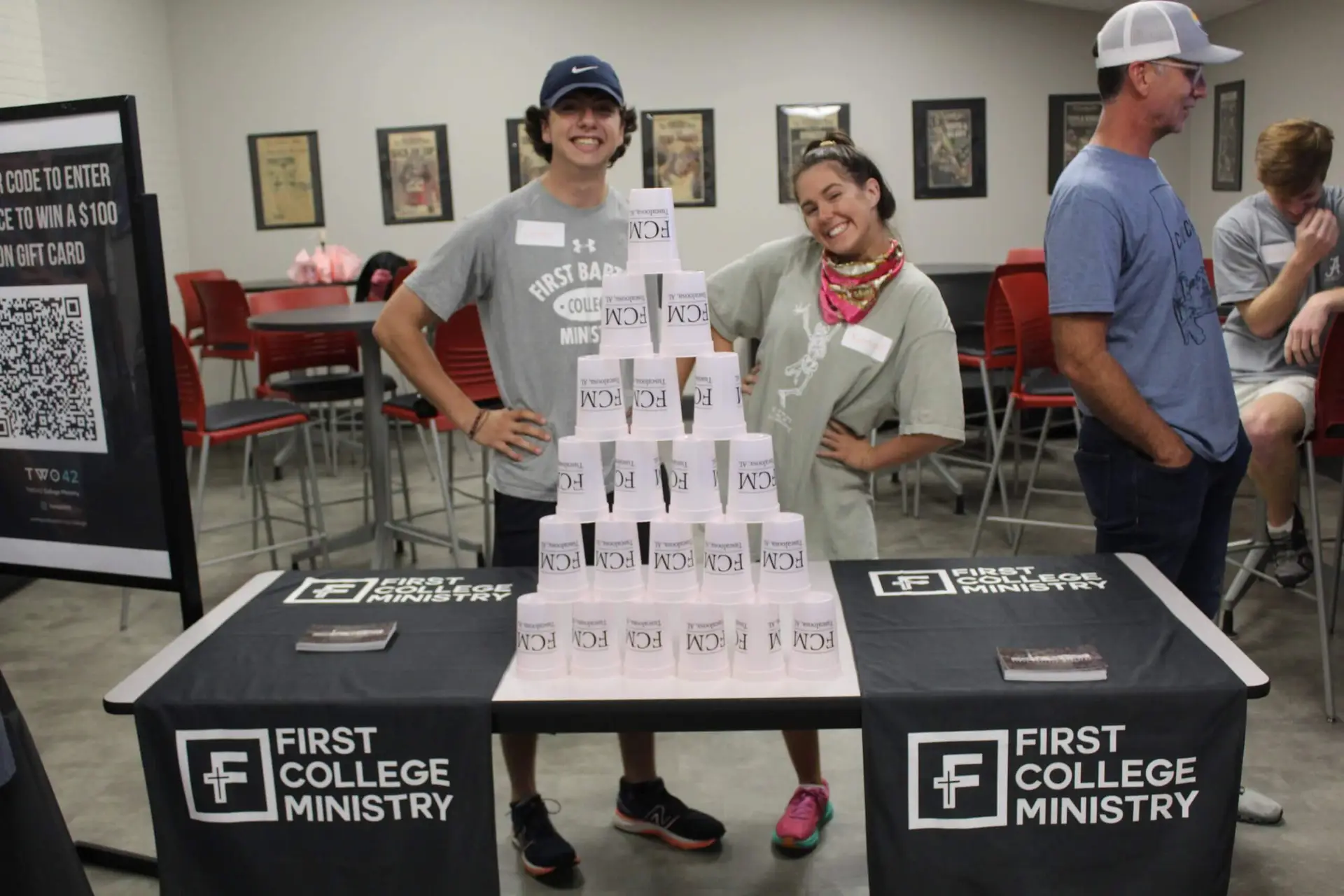
Even on a small or tight budget you can make things look neat and organized and that you have something to offer the students that is priceless. Get a tablecloth ( keep it neatly folded to avoid wrinkles), have some fliers or cards about your ministry available, have out out some Bibles or Christian books that you can give away, and if you can afford it, have something to give out- candy, water, granola bars, etc.

2. Have a way for a student who comes to express themselves

A white board with a question of the day will get them to engage with you about what they think. Be cautious with what your questions are- don’t make them too controversial or you’ll only get into arguments! And don’t make them too cheesy or easy, or there’s no way to move to a spiritual conversation authentically.

3. Train the students or volunteers or staff who are working at your outreach activities in the art of exchanging personal phone numbers.

Some use a questionnaire or form to sign up for some drawing or to get more information about your ministry. I think doing these is fine as long as I do more than dump their contact into a mass texting service. If I’m working at an outreach activity and a student fills out my form, I put my name on the form somewhere so I can do the personal follow up with them in addition to sending them mass invitations to our ministry.

4. Pursue personal relationships in all follow up efforts.

Invite them to get coffee or lunch together but spend that time getting to know them and hearing their stories more than you advertise your ministry. And stay in touch over the long haul of the semester. You may have more intense activities during the starting weeks of the semester but if you drop off your efforts to contact and communicate with those you meet it smacks of inauthenticity.

I recently asked some student leaders from a variety of campuses in our state to share their thoughts on outreaches with me, and they were spot on. They said things like holding outreaches in non-religious centers on campus (think outside of your own ministry centers if you have one). They also suggested pairing up and attending events hosted on campus by other organizations or groups. According to these leaders, including food is always inviting to college students.They are intrigued about learning about other cultures, religions, and people groups so find ways to engage in activities that open those doors. They also suggested service to other students like dorm trash takeouts as an outreach strategy.

If you are trying to reach a certain population on your campus, invite local church partners to help you. In Texas we have campuses with large percentages of Hispanic students, so we like to invite our Spanish speaking or Hispanic heritage congregations to partner with us to reach these students. Often the church would love to make some connections; they just don’t know how to access the campus in healthy and meaningful ways. Invite them to partner with you in doing outreach to these specific students.

And finally…

question I was asked recently: what’s a good frequency for doing outreaches? If our primary calling or goal is to share the gospel with lost students, shouldn’t we be doing outreach activities as much as possible? (I cringe when a worker cites our minimum standard as the goal they are happy with.) This is especially true when the campus is full of lost students. If every student leader is engaged in outreach activities and if you practice the Jesus-.way of sending disciples out in pairs to do ministry, you should have at least one outreach for every 2 student leaders you have.

What if you don’t have any student leaders yet?

You personally should be engaged in as much outreach as you can humanly manage. I would schedule part of every day I was on campus with some type of outreach effort.  Sometimes these would be formally organized- like a BSM table in the student center. Sometimes these would be more informal- like starting a conversation with a student in the quad. All of these were preceded by prayer for the Spirit to enable me to say what needed to be said and to listen to what the student was sharing with me.

 May you be encouraged to try new things and connect with more students by being intentional with your outreach activities!

Beth Smith is a Campus Consultant for Texas BSM. You can email her at beth.smith@txb.org.