God Moving in AZ!

God is moving in Arizona! This year,  Challenge AZ is partnered with 20 local churches reaching out to 24 college campuses. There are 35 missionaries spearheading these ministries. Below is an update from Ellie Lambert, Campus Missionary at Arizona State University’s downtown campus.

“At the end of 2025, I celebrated 5 years of serving with Christian Challenge as a collegiate missionary!

When I started my college journey, I had no idea the Lord would call me into vocational ministry, but I am so thankful for his intentional and careful direction in my life. Through Challenge I have been able to cultivate a lifestyle of living out the gospel, sharing Christ’s love with others and raising up leaders for his church.

This semester we have a student leadership team of eight: one senior, three juniors, three sophomores and one freshmen. Together they are leading two small group bible studies on campus as they dive verse-by-verse into the book of Genesis. Please be praying for our leaders and these intentional small group studies.

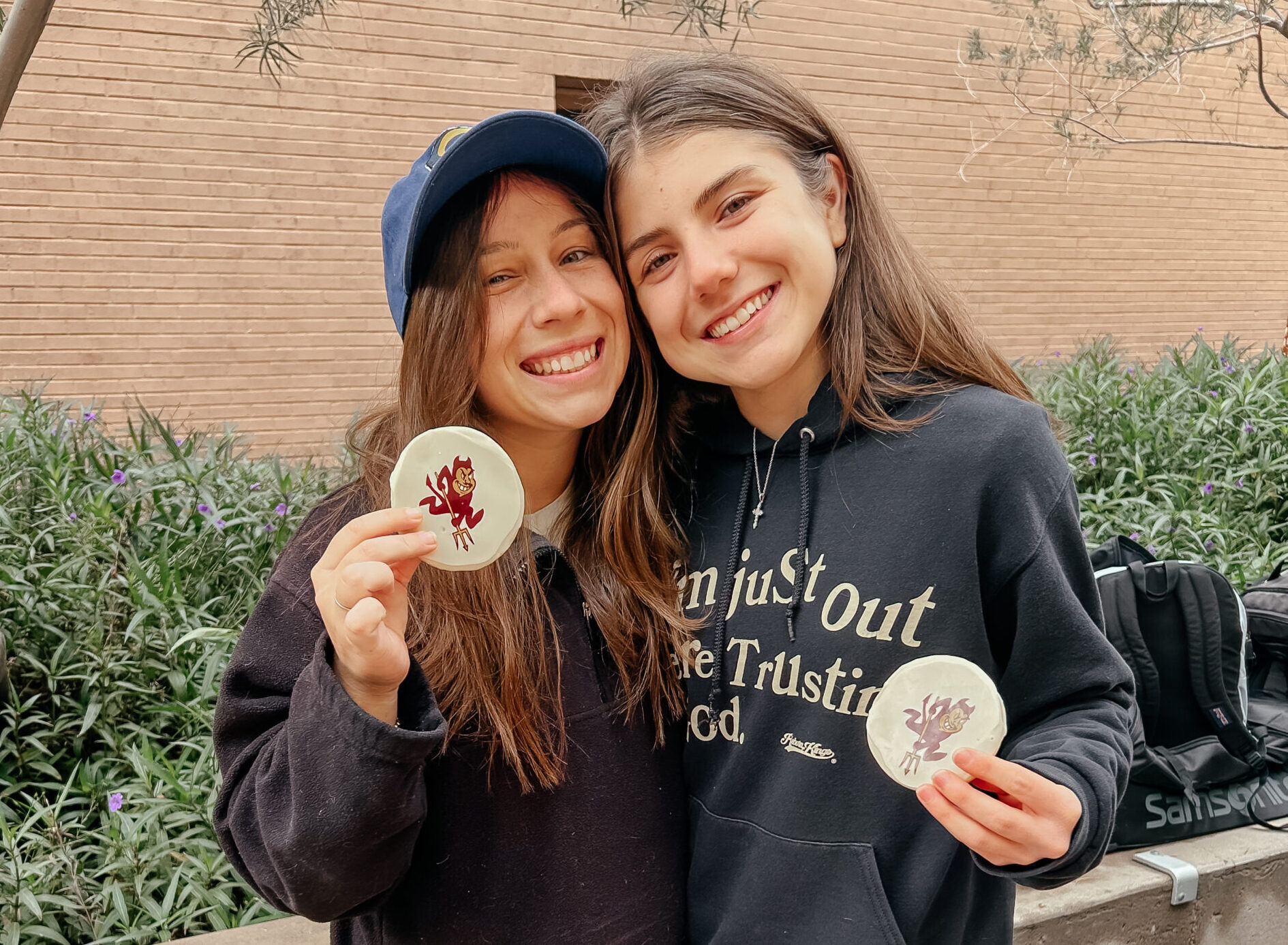
One leader I have had the pleasure of growing close to in discipleship and development is Rhiannon. (Above is a  photo of Rhiannon and I at tabling.) Rhiannon was a brand new believer when I first met her freshman year. Since then she has grown exponentially in her faith and enjoys discipling other girls, sharing the gospel with anyone she meets on campus, leading bible studies and organizing missions projects. It is clear the Lord has placed a call to ministry on her heart and she has been working closely with me to take on some of my role as a missionary. Praise God for her faith and growth! It is a true joy to watch as the Lord uses our ministry to mobilize servants for his kingdom!”

You can follow the ministry at ASU DT on Instagram @challengeasudt, and Christian Challenge AZ @christianchallengeaz.  

International Student Ministry: Thankful for God Moving!

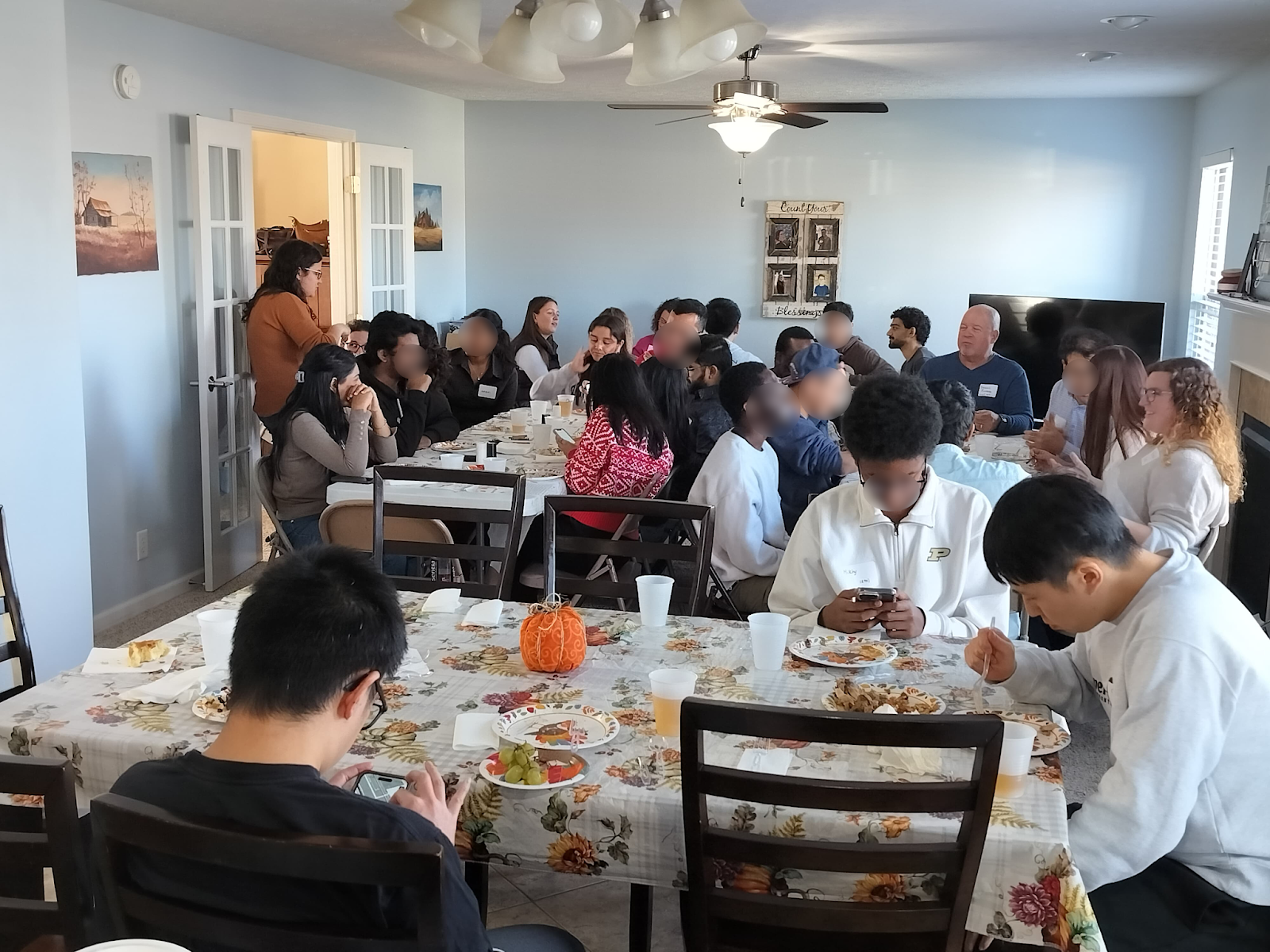
This school year has brought about some new challenges in our world of international students. Across the United States, the number of international students has greatly declined because of the political climate. It wasn’t a surprise, but we have seen its effects now. However, this past Thanksgiving was wonderful! At Purdue University, we have a program created by our university called, “Host-A-Boiler”. In this program, international students can sign up with it and be assigned to enjoy a Thanksgiving meal with a family from the community.

For our organization, Launch Campus Ministry (formerly known as the Purdue BCM), and families, we hosted over 60 students between two homes. We had students from 16 different countries. Between two homes, we prepared over 34lbs of turkey and 10lbs of ham. It was a wonderful experience for everyone involved.

One Korean grad student shared, “Thanks so much for your invitation! I truly enjoyed the food. I was alone and lonely, but you helped me a lot.” Another Columbian grad student shared, “Thank you so much for hosting us! It was a wonderful Thanksgiving day and a great opportunity to learn from different cultures. God bless you and your family!”

Some Gospel conversations were had, but hospitality speaks loudly as well. We would highly recommend finding ways to show the biblical practice of hospitality to the “foreigner” as often as you can. It is a sacrifice, but a rewarding one at that. Hebrews 13:2: “Do not neglect to show hospitality to strangers, for thereby some have entertained angels unawares.”

Dennis Runner is the International Team Minister with Launch Campus Ministry at Purdue. Learn more about the ministry at launchcampusministry.com.

Saying Goodbye to Graduating International Students

Giving international students a good send off and finding ways to stay connected is so valuable in keeping an ongoing relationship with them. It is encouraging to see God at work in their lives, even beyond the time they spend on your campus.  As the semester is ending, here are things to consider as students are graduating or transferring to another college.

  1. Determine the best way to stay in touch – Signal, Whats App, Instagram, Telegram, etc. Some of these communication tools need to be set up before the student leaves the country.
  2. They may need help distributing items they are not planning on taking with them, such as household items, bedding, etc. If you have a place to store them, you can offer them to incoming students in the fall. If not, you can help them get the items to a donation spot.
  3. Plan a recognition service where you can thank them for their time with your ministry. Provide some type of gift. The BCM where I served had a picture of the city of Atlanta with the verse Numbers 6:24-26 imprinted on it.
  4. Set up time to meet where you can make sure they understand the message of the gospel.
  5. Connect them with any Christians you know in their home country if they are graduating or at another university if they are transferring. If you need help finding a connection, you can contact me at troyall.bcm@gabaptist.org.
  6. Pray that these students will connect with Christian community at their next destination. I had a student from Malaysia who heard the gospel message several times but was not ready to profess faith in Christ. However, after returning home, she connected with a Chinese Christian group who reached out to her. Through involvement with this community and her being aware of the gospel message while in the BCM, she became a follower of Christ.

Teresa Royall is the Campus Expansion Consultant for Georgia.

Recruiting and Leading Next-Level Leaders

It’s been said that who leads your college ministry will largely determine who your college ministry will reach. I’ve seen this to be true over and over again. The selection of staff and lead team members matter, and it ripples (or doesn’t) throughout campus. 

When selecting lead teams, select leaders from the parts of campus that you want to reach. If you want to reach all sections of campus, ask God to open doors with leaders who represent all parts of campus. This includes gender, melanin, and campus activities such as sports, clubs and Greek life.  Seek students who spend time in a variety of campus locations as well, including an assortment of residence halls, apartment complexes, and academic buildings. 

Share a clear and honest vision and invite leaders into the vision.  King Solomon’s wisdom in Proverbs 29:18 speaks to this; “Where there is no vision, the people perish.”  Repeat the vision of your ministry often, keeping leaders on track and affirming the part they play in it. 

Enlist people who are NOT like you yet have chemistry with you and are unified with the vision of your ministry. Try to include people who are introverts and extroverts, morning people and night owls, planned and spontaneous, detailed and big picture, grace and truth, risk takers and safe players. Paul encourages believers in I Corinthians 9:20 to “be all things to all people so by all means possible some might be saved.”

Engage people who are already leading, not necessarily in your ministry but on campus. These are the students who people want to be around. If they throw a party, everyone will want to come.  In Henry Blackaby’s Spiritual Leadership, he states that “a spiritual leader leads all people not just church people.”

Some common characteristics of next-level leaders include:

1. Next-level leaders can lead themselves. 

Spiritually and emotionally, they aren’t perfect but they are committed to the journey of growth. John Maxwell has said that “the secret of your future is found in your daily routine.” Eugene Peterson writes, “The spiritual life is long obedience in the same direction.” Next-level leaders are committed to following Jesus, one good habit at a time.

2. Next-level leaders relate well to a wide variety of people. 

Romans 12:10 says, “Love each other with genuine affection, and take delight in honoring each other.” This kind of leader can walk in the middle of campus and be at home with whoever they may find there, showing honor to the sinner and the saint alike.

3. Next-level leaders are humble.  

Philippians 2:3-4 says, “Don’t try to impress others. Be humble, thinking of others as better than yourselves. Don’t look out only for your own interests but take an interest in others too.” They have the correct perspective about their own weakness, sin, and need for God. This allows them to easily enter into another’s life with grace and humility.

4. They are spiritually aware. 

We read in Galatians 5:25, “Since we are living by the Spirit, let us follow the spirit’s leading in every part of our lives.”  It truly is a paradox – God has called us to do something that only He can do.  Spiritually aware leaders get this. 

5. Next-level leaders are eager for more. 

Jabez’s mom named him a Hebrew word similar to a word meaning distress or pain because his childbirth was so painful. He prayed the opposite of this for his life, and God granted his request. His prayer is found in I Chronicles 4:10.

“Oh, that you would bless me and expand my territory? Please be with me in all that I do, and keep me from all trouble and pain?” Next-level leaders hope for more, pray for more, and plan for more!

6. They are high-capacity leaders. 

Galatians 6:10 teaches, “Therefore, whenever we have the opportunity, we should do good to everyone…” Next-level leaders tend to respond to opportunity with, “YES!” They are committed to excellence, which is different than being a perfectionist, and they don’t get too bent out of shape with lots of moving parts. 

7. Next-level leaders have a bend for both visionary leadership and practical leadership.

They will likely have a natural gift of one or the other, but they see the value of both seeing the big picture of where we would like to go and how we can move from point A to point B. 

Next-level leaders need and appreciate several things from you, including clarity, freedom, and time. Lead with clarity. Let your leaders know what you want from them, what result is desired, and the why behind the tasks. Repeat the why or the vision often. Give your high-capacity leaders freedom to lead with a safety net if needed. Show them how something is done. Do it with them. Watch them do it and give feedback. Finally, let them do it alone. Let them know you are in it with them and have their back. Failing forward is still a win. Give them regular time with you to share life, speak truth, and develop them as leaders and disciples. This can be as little as 45 minutes every two weeks or as much as an hour per week, but the key is for it to be a consistent priority. 

Once these high-capacity leaders say yes to serving on your team, invest in them in a way that makes them want to continue!

Linda Weir is Director of Ministry at Pinelake Church in Starkville, Mississippi. You can follow Pinelake’s Starkville campus on Instagram @pinelakestarkville.

Kingdom Impact Through Vocational Discipleship

“What is God’s will for my life? I think I’m going to change my major. What do you think I should do? I’m freaking out because I’m graduating and have no idea what to do next. Can you help me?” How often do you get questions like these from students? 

We all desire work that is fulfilling, meaningful, and aligned with who we are and who we strive to become. However, such opportunities are hard to find. The statistics consistently show this, but you don’t need to hear them; you see it around you—in people you know who feel unfulfilled, unhappy, burdened, and depressed by their jobs. It is frustrating to witness students struggle without effective tools or frameworks to address their challenges.

Students are at a stage where some key input from seasoned leaders could have a lifelong impact in this area. Because they don’t know their purpose, students often lack passion and confidence in their vocational direction. They struggle with anxiety, disengagement, and apathy because they lack clarity or a sense of God’s direction in their career choices. You have the potential to help every student you know avoid the trap of unfulfilling work.

Every student is unique, individually called by God, and gifted in special ways. Yet few are aware of how these factors should impact their lives or vocations. They need assistance in discovering a path that leads not just to a good job but to a fulfilling life centered in God’s design for them. To build the right foundation, they must ask the right questions, gain a clearer understanding of themselves, and gain real-world experiences and feedback.

Implementing a vocational discipleship plan for your students likely requires only minor additions to your current activities. However, the level of insight and deeper conversations with students could be revolutionary. Helping them find the intersection of their gifts, strengths, passions, and preferences with their calling will guide them toward career fulfillment, confidence, effectiveness, and the freedom to advance the Kingdom as they lead in ministry, mission, and marketplace.

The process requires two crucial building blocks: information and application.

These blocks enable students to ask the essential questions needed to discover their calling. To grow, you need a solid understanding of yourself, knowledge of your options, and an honest assessment of your current reality. With this understanding, you can develop a plan and take actionable steps to move forward. As students apply this information and gain experience, they will progress further and faster with a guide who regularly evaluates their progress toward their goals. When you create opportunities for students to engage in real work and receive constructive feedback, growth can occur rapidly.

Information is the first step, and you don’t need to reinvent the wheel.

Many great discovery tools are available to help students get to know themselves. The best tools reveal students’ motivations, preferences, interests, behavioral tendencies, strengths, weaknesses, and growth opportunities. Great books and online tools can help, as can assessments like Strengths Finder or the Harrison Assessment, which I use almost exclusively. Some are inexpensive or like the Harrison Assessment require some investment.

The key is creating a systematic way of ensuring students in your ministry have a dialogue about these topics. Simple tweaks and additions to how you develop students to create vocational discipleship opportunities can have a game-changing impact on student confidence in this area. 

When it comes to Application, it is about the process.

You likely already do this, at least with your student leaders, interns, and staff. This should include planning, implementation, testing, feedback, course correction, and redirection. You can do this through group interactions with your leadership team and in one-on-one sessions as well. 

For leadership development to be effective for our students, it must include at least three elements: a plan or task that provides them with something to accomplish; implementation, where they actively engage in the task—typically, the best learning tasks are repetitive and occur consistently over a semester; and finally, reflection, where they can think about the positives and negatives, consider potential improvements, and receive feedback on how they can improve. 

Reflection is where you provide the most support. Asking insightful questions prompts them to pause, reflect, and possibly change their behavior, attitude, or thoughts to improve and change. I’ve found that coaching is the most effective format for this process. In coaching, the student is the one doing the thinking and reflecting; you don’t do it for them. By asking good questions, you help them draw out what went well, what needs improvement, and how to create a plan for next time. Personal ownership is crucial.

One of the greatest strengths experienced Collegiate Ministers have is their capacity to effectively gauge students’ spiritual and emotional health. Often, through a few conversations, you can gain a solid understanding of a student’s maturity and developmental needs. Tools like the Harrison Assessment offer extremely accurate and quick insight into these same dynamics, removing guesswork. The knowledge acquired in a single session reviewing a student’s results dramatically shortens the time needed for discovery through one-on-one meetings. This speed in understanding students can greatly enhance their growth during their time in your ministry. 

Here is my encouragement:

  1. Find ways to talk about vocation and calling with your students, and develop a process for students to discern not only calling to ministry and mission but to the marketplace. 
  2. Develop your coaching ability; this has been a game changer for me personally. Going through some training to understand the fundamentals of using coaching as a tool with our students has totally changed how we have conversations, and produces much more student ownership of outcomes. 
  3. Build your vocational discipleship toolbox.  If you would like to request a free demo of the Harrison Assessment, email me at chad.wilkin@gmail.com

Your impact in this area has countless potential ripples. Students with a fulfilling vocation aligned with their calling, empowered to influence God’s kingdom, represent a beautiful vision. It’s disheartening to see students continue to grapple with confusion about majors, vocation, direction, and calling, particularly when they lack effective strategies for support. Surely, God’s plan is to deepen the pool of potential ministry and mission-focused students. The process isn’t complicated, but it’s not always easy. If you would like to continue this conversation, I would love to talk!

Chad Wilkin is the co-director of the BCM at Indiana State University in Terra Haute, Indiana.

Sharing Jesus with International Students

Developing the Vision in Our Students and Congregation

In today’s fast-paced world, the need for clarity and engagement in our communities has never been more important. Whether we are speaking to our students or our congregation, establishing a strong vision is paramount for fostering genuine participation and growth. 

The Importance of Developing the Vision

To effectively engage our students and congregations, we must illustrate what they are joining in on. The first step in this process is to articulate a compelling vision. In our organization, Launch Campus Ministry, we have specific teams assigned to different aspects of our organization. Initially the team we had set aside to engage with international students was titled the “International Team.” The name of the team inadvertently conveyed a message that excluded many who might have participated. We learned this lesson through trial and error, transitioning to the more descriptive “Cross-Cultural Team.” This change not only clarified our purpose but also highlighted our mission to foster cross-cultural friendships rather than simply existing for only international students.

For a vision statement to resonate, it needs to be clear and simple. Overcomplicating our messaging can lead to confusion and disengagement. For example, one straightforward vision statement could be “Reaching students from all cultures.” This simple phrasing encompasses our goal without adding unnecessary complexity. 

Each group—whether it consists of students or members of a congregation—will possess a unique “DNA” that affects outreach efforts. This diversity should be embraced rather than avoided. For instance, our students on our campus identify with a certain culture; they are typically more “nerdy” than athletic. Thus, reaching out through sporting events may not be the most effective strategy. It is vital to assess the specific attributes of our international student body as well; for example, some Nigerian male students typically gravitate toward sports like soccer, while a lot of Bangladeshi female students often find joy in dressing up. Understanding these nuances not only allows us to tailor our outreach efforts but also equips us to engage meaningfully with those we serve.

Relationships Are Greater Than Events

While events can be a means of creating community, it is relationships that ultimately lead to impactful Gospel interactions and a fruitful community. Therefore, our vision should serve as a foundation for building these vital interactions. By prioritizing relationships over mere programming, we can create an environment where individuals feel valued and connected. The trust built within these relationships will allow the Gospel to be received with freedom. 

To facilitate this, we encourage idea-sharing conversations among our group members that can guide training and engagement efforts. These discussions can help us identify practical challenges and obstacles that may inhibit relationship-building with those we are inviting to join us. From there, we can work together on solutions while ensuring that our efforts remain grounded in shared purpose. To avoid these discussions, unity among the group will be impossible. 

Practical Challenges and Obstacles

Navigating the landscape of outreach and engagement can present specific hurdles. You may have different schedules than the students you are trying to reach? Strive to be flexible. Be willing to take advantage of small increments of time. Even making yourself available via texting or phone conversations can build open communications. 

You may struggle to find common ground? There is always common ground to be found. One way to begin conversations is with the two-handed approach (FFFFF & WWWWW)- family, friends, future, festivals, family & who, what, when, where, why. Any combination of an “F” and a “W” are simple ways to begin and sustain conversations. 

Simply being a learner will show a person that you want to be a true friend. 

Evangelism and Bible Study Ideas

As we engage our students and congregation, provide opportunities for evangelism training and spiritual growth. Some potential strategies might include:

  • Creating Events that Facilitate Gospel Conversations: Design gatherings that encourage open dialogue about faith in a relaxed setting. Some examples include: movie nights with discussion questions, taking international students to church as observers, even weddings.
  • Training and Engaging in “Raw” Street Evangelism: Approaches such as the “3 Circles” method can help prepare our community for real-world discussions about faith. Training on different religions and how to engage them with the Gospel. 

When it comes to Bible studies, there are several engaging formats we can explore:

  • Discovery Bible Studies (DBS): These studies allow participants to explore Scripture collectively and draw personal insights.
  • Investigating Christianity: Our version spans the fundamental aspects of faith in an accessible way.
  • Christianity 101: A foundational overview of the Christian faith.
  • “What Do Christians Believe?”: This format invites questions and provides solid answers.
  • “Story Friday”: A narrative-driven approach to sharing faith stories.
  • Works by Lee Strobel: Titles like “Case for Christ” and “Case for Easter” offer investigative insights into Christianity.

Conclusion

In conclusion, developing a clear vision amongst our students and congregations is essential for fostering engagement and facilitating genuine friendships. By emphasizing relationships, understanding the unique attributes of each group, and providing practical strategies for outreach and spiritual training, we can effectively guide our groups toward a shared purpose: making disciples of Jesus. 

Dennis Runner works at Purdue University as the International Team Minister for Launch Campus Ministry. You can learn more about the ministry at launchcampusministry.com.

COLLEGE MINISTER: WHAT IS YOUR MISSION & VISION?

Why do you do college ministry? What is your ministry’s specific mission? How do you accomplish it? How do you know if you’re on target? Can you put these things into concise and compelling statements? 

Getting clarity on your mission and vision is essential for a leader who wants to impact the next generation for Christ. Moreover, putting your mission and vision into clear, concise statements allows you to recruit others to the movement. A good mission statement becomes an anchor that reminds you of “why” and “what” you’re doing. It also allows you to share the mission with others and invite them to join!

Lots of college ministries know WHAT they do. They engage in outreach and promotion, organize Bible studies and worship services, and plan mission trips and social events. Fewer still can clearly and concisely articulate WHY they are doing it and how it connects to Jesus’s Great Commission in Matthew 28. A good mission statement communicates both the “what” and “why” of your ministry. 

Will Mancini differentiates a mission statement from a vision statement. In Church Unique, he describes five facets involved in building out your “Vision Frame” for your ministry.

  1. MISSION (mandate) – What are we doing? A clear and concise statement explaining what your ministry is committed to be doing. The mission MUST be connected to Jesus’s Great Commission in Matthew 28:18-20 but applied to your specific context.
  2. VALUES (motives) – Why are we doing it? What is important to us? These shared convictions guide actions and reveal the ministry’s strength. 
  3. STRATEGY (map) – How are we going to do it? Strategy is the process or picture that demonstrates how your ministry will accomplish its mission on the broadest level. Strategy is a plan. It shouldn’t be overly elaborate. Focus on doing a few simple things like disciple-making, evangelism and leadership development really well.
  4. MEASURES (marker) – When are we successful? Measures are attributes that define or reflect the accomplishment of the mission. They are things you track! Measures are milestones that allow you to evaluate progress. Measures could include the number of small groups, the number of students engaged, the number of alumni joining staff or being sent, etc. There are both “lead” measures and “lag” measures. Lead measures are things you have control over, such as the number of new students you contacted and how many gospel shares you made. Lag measures are the results of your activities, like how many people attended an event or how many professed faith in Christ. Which should you track? Both! 
  5. VISION PROPER (mountaintop + milestones) – Where is God taking us? Vision Proper describes an anticipated future. These are God-sized but measurable and attainable goals. Ideally, Vision Proper describes success as 2-5 years in the future. This isn’t a pie-in-the-sky wishlist like, “We want to see ten thousand students saved!” It answers the question, “If God blessed all of our current plans, where would we be in 2-5 years?” It’s attainable with God’s help. 

Mission never ends because the work is never done until Jesus returns. Vision keeps us motivated because, by faith, we can see God accomplish it in the intermediate future. Andy Stanley says, “Vision is a clear mental picture of what could be, fueled by the conviction that it should be.” Mission is a not-until-Jesus-returns activity of the church. Vision CAN be accomplished. We can’t just stay motivated by mission because it’s too far off. We need a VISION of where our ministry could be, by God’s grace, in 3-5 years.

In the campus ministry that I led for 21 years, BSM at the University of Texas Arlington, here were ours:

  1. MISSION: To lead college students to become lifelong disciples of Jesus.
  2. VALUES: Christ as the Center of Everything, God’s Word, Prayer, Accountable Community, and Witness. (You might recognize these from the Navigators Discipleship Wheel, a resource we utilize in our discipleship. Don’t be afraid to borrow stuff that works!)
  3. STRATEGY: Evangelism, Discipleship, Missions. We strive to WIN college students to faith in Christ, BUILD them into mature disciples of Jesus, and SEND them as lifelong Gospel workers.
  4. MEASURES: We track lots of stuff!
  5. VISION PROPER: To increasingly saturate the campus with a gospel witness by pioneering two new niche ministries per year and to pioneer a new campus ministry at an additional local campus every 2 years. To have 10% more students meaningfully engaged in discipleship every year for the next 3 years. To send 25 graduates to campus ministry staff or the mission field in the next 5 years.

If your mission statement is clear and also emphasized repeatedly, then it helps keep your ministry from drifting away from the mission. 

One question that I’ve been asked is, “Should you share your mission statement word-for-word or paraphrase it?” The danger of reciting it word-for-word is students may feel like it’s canned or that you are trying to brainwash them. It can feel inauthentic. When you share it word-for-word, make sure you communicate naturally and from the heart. The danger of paraphrasing is that students might not catch the vision. It’s not clear and sticky enough, so they don’t remember it and can’t repeat it. 

In our campus ministry, we repeated the vision like a broken record. Sometimes paraphrased, sometimes word-for-word. “God put you on the campus to help reach others for Christ.” “God wants to grow our faith so we can reach people Jesus for the rest of our lives.” Repeating the mission and vision is one key to creating a strong culture in your ministry. So, repeat the mission. And repeat the mission.

So what are yours? Do you already have a thoughtful statement of your mission, values, and vision? Does it need improving? If not, take some time to pray, dream, and create a God-sized, Great Commission mission statement!

Gary Stidham is the Director of Training for Texas BSM and Adjunct Professor of Collegiate Ministry at Southwestern Seminary. For more helpful articles and information, check out garystidham.com.

This article was originally published on Via Students.

Remembering the Why

Whether you feel like you are killing it or barely surviving, it’s easy to lose sight of why we do college ministry. Too often, we lean on large turnouts and ministry “successes” for confidence in our call, or allow facing challenges to make us question it. That is a recipe for burnout. If we’re not careful, the rigors of ministry, the disappointments of unmet expectations, or the challenges inherent in student work will wear us down. There will be times when students are flaky, stats don’t reflect the effort you’ve put in, budgets are slim, friends in ministry are distant or nonexistent, family members wonder when you’ll get a real job, and there’s more work to do at every turn. Remembering why we engage in college ministry and how God called us to do this work is so important for ministry longevity! 

In 2 Timothy, Paul clearly perceived the need for Timothy to be encouraged in ministry and, perhaps, to remember why he was in ministry in the first place. In this letter from mentor to mentee, we find four simple, biblical motivations for ministry to encourage us as we remember why we do this work. 

Remember the Gospel.

Paul reminded Timothy: “He has saved us and called us to a holy life – not because of anything we have done but because of his own purpose and grace. This grace was given us in Christ Jesus before the beginning of time” (2 Tim. 1:9). We are God’s children by his grace alone, and we serve in ministry by grace alone. I must frequently remember that God could accomplish his purposes in collegiate ministry just fine without me. It’s a gracious gift to get to be a part of his redemptive work in the world! By his grace, you are his child, and by his grace, you are a minister of the gospel! Remember, God doesn’t need us to do ministry but he wants us to be with him! A missionary friend recently shared, “Passion will only get you so far. Obedience will take you a little further. But loving Jesus will sustain you.”

Remember the Call.

Paul encouraged Timothy in the simplicity of his calling: “You then, my son, be strong in the grace that is in Christ Jesus. And the things you have heard me say in the presence of many witnesses entrust to reliable people who will also be qualified to teach others” (2 Tim. 2:1-2). Timothy was to stay rooted in Christ, pass on what he had learned and experienced, and teach others to do the same. If we overcomplicate our calling, we are in danger of becoming strong in strategy and measurable success but weak in “the grace that is in Christ Jesus.” Steve Smith challenged that while effective methodologies are crucial, “methods are mere mechanics without the Spirit of God.” Admittedly, simple doesn’t mean easy. Whether your “calling” to ministry was a memorable experience or a gradual progression of steps of obedience, remember, God is the one who called you, equips you, and empowers you.

Remember your Mentors.

Paul reminded Timothy that his understanding of the gospel and calling to ministry were not experienced in a bubble. “But as for you, continue in what you have learned and have become convinced of, because you know those from whom you learned it” (2 Tim. 3:14). As Timothy’s mentor, Paul had vivid memories of Timothy’s call and a unique position to remind him of God’s work in his life. We need true brothers and sisters in Christ who can speak into our lives, encourage us, challenge us, hold us accountable, and remind us why we do this work.

Remember to Persevere.

“But you, keep your head in all situations, endure hardship, do the work of an evangelist, discharge all the duties of your ministry” (2 Tim. 4:5). Paul knew there would be times when ministry would be rough, people wouldn’t listen, and some would replace Timothy’s voice with “what their itching ears want to hear” (2 Tim. 4:4). Paul expected Timothy to remain faithful to his calling even when things went poorly. I’m convinced that Paul would reject a myth often believed in our culture: that hard means bad, that if things are not easy or fun, something must be wrong. Ministry challenges can teach us more about God’s character and faithfulness and help us better understand ourselves. Facing challenges as learning opportunities is a far simpler prospect when we are confident in the gospel, remember the substance of our calling, and allow our community to speak into our situation. 

Years ago, I spent an entire summer wrestling with whether I was “still the guy” for our ministry on campus. After much prayer, reflection, and even a little looking at other job opportunities, God made it clear that I’m not the guy; HE is…and that I needed to stay as a participant with God in HIS ministry. I have had to relearn this lesson over the years and have found it helpful to define roles and establish a personal mission statement. When I face a challenging season, need to make a significant decision, or just remember why I’ve given my life to collegiate ministry, it is helpful for me to remember God’s role, my role, and what he’s called me to. 

I’ve written mine from my season as BSM Director at UT Tyler below (I’m working on a new one for a new role in TX BSM). Perhaps developing something similar would be helpful for you as well.

By God’s grace, I am a participant in His ministry and get to work with Him… 
To: Saturate the harvest fields of the world, domestic and foreign, with thoroughly equipped workers.
By: reaching, discipling, and sending UT Tyler students to the nations.

Joe Osteen serves as the East Texas Regional Director for Texas BSM. You can follow him on Instagram @JosephOsteen.

Discipleship: More Than a Buzzword

When you look around churches and ministries everyone seems to be talking about discipleship but very few seem to be seeing real reproducible success in disciple-making. “Discipleship” has turned into a buzzword more than a reality. 

God has placed us in our ministry context to make disciples. This is the primary thing that we are called to do. Everything we do is to serve this goal: to see a footprint be left for Jesus on our campuses. We can look at our stories, we can look at others’ stories around us and we can see the importance of discipleship. But it is also part of the story that God is writing through His Church. Intentional, reproducible discipleship was Jesus’ idea. 

JESUS MODELED DISCIPLESHIP. 

JESUS COMMANDED DISCIPLESHIP

19 Go therefore and make disciples of all nations, baptizing them in the name of the Father and of the Son and of the Holy Spirit, 20 teaching them to observe all that I have commanded you. And behold, I am with you always, to the end of the age.” – Matthew 28:19-20 

JESUS DID NOT SAY GO AND MAKE LARGE GATHERINGS. JESUS SAID GO AND MAKE DISCIPLES. Just to be clear, God uses gatherings and large gatherings are not wrong, but they are not the ultimate goal. They are a vehicle. 

When we look around at the college campus one thing is clear: Jesus is still building His kingdom. Jesus is still writing the story. He has invited us into it. One of the primary vehicles is intentional discipleship. 

Discipleship multiplies, and there is power in multiplication. If we won one person to Jesus every week for the next 16 years we would reach 932 people. If we won one person to Jesus every day for the next 16 years we would reach 5,840 people. If we won one person to Christ every 6 months and discipled them and helped them reproduce their lives into someone else every 6 months (and it worked out perfectly), then in 16 years we would reach 6,442,450,944 people. There is power in multiplying discipleship. 

But we have to define what a disciple is. Definitions matter. They bring clarity. 

1) A DISCIPLE IS SOMEONE WHO ADHERES TO CHRIST (MARK 8:34) 
2) A DISCIPLE IS SOMEONE WHO ABIDES IN CHRIST (JOHN 8:31) 
3) A DISCIPLE IS SOMEONE WHO ADVANCES THE GOSPEL OF CHRIST (MATT. 28:19-20) 

If that is what a disciple is… then how would you define discipleship?

A great working definition is: DISCIPLESHIP IS TAKING THE NECESSARY TIME TO WIN, INVOLVE, AND TEACH SOMEONE HOW TO FOLLOW JESUS. 

It is an intentional relationship. It is a time of practical training & accountability. It is a time of modeling. It is about multiplication. What if we could see this happen regularly & in a reproducible way? What could God do if we made this a top priority in our ministries? 

When it comes to discipleship we want to see TWO MAIN GOALS ACHIEVED: 

1) FULFILLMENT OF THE GREAT COMMANDMENT (SPIRITUAL GROWTH) –  MATTHEW 22:34-40. 
2) FULFILLMENT OF THE GREAT COMMISSION (SPIRITUAL MULTIPLICATION) – MATTHEW 28:19-20. 

College students are a strategic and important group of people in which to see this advanced. You know this. This is why you are in college ministry. They are going to step up and lead in churches, workplaces, and families. We have to disciple our college students well. 

What we have done is we have put together a “Discipleship Toolkit” to help you navigate this conversation in your ministries. All of us want to see this be a priority but sometimes we just don’t know where to start outside of gatherings and small groups. These are great but I believe there is another level. 

This is why the “Discipleship Toolkit” can be helpful for you. We have pulled together some people seeing real success in this area in their ministries to address critical topics in seeing discipleship move from a buzzword to a reality in your ministry. The “Discipleship Toolkit” has nine sessions that address: 

  1. Defining Discipleship. 
  2. Importance of Culture and how to build it. 
  3. Developing a game plan. 
  4. Developing disciples from spiritual activity to spiritual maturity.
  5. Packing the right tools. 
  6. Overcoming Distractions 
  7. Disciple to Disciplemaker 
  8. How it starts with you. 
  9. How to partner well with your local church.

There are videos & discussion guides to walk you through major thoughts & questions. You can find it at https://baptistcollegiatenetwork.com/ministry-areas/discipleship/

We pray that it is helpful for you and that God uses you to help real people become real disciples who make real disciples. I believe with my whole heart that God has placed you where you are and has entrusted you with students to see them know and follow Jesus wholeheartedly. What an honor we have to make disciples. Nick Parsons is the Pastoral Ministry Associate for College and Young Professionals at Center Point Church. You can reach him at nick@cpclex.org or follow him on Instagram @nickgparsons1 or @collegecpc.

Maximizing the Holidays for International Outreach 

I’m sure you know that the nations come to the United States to study on our campuses every semester. They are excited to pursue a higher education abroad, and experience American culture close up. Students have all kinds of expectations of making new American friends, visiting American places, and trying American food! However, because it is often easier for them to connect with people like themselves or from other international cultures, they often find it difficult to connect with American students. 

Did you know there are international students who come to the United States for their degree and never get invited into an American home? We can change that during this holiday season! Below are a couple ways we have done this. We hope you will be creative and discover your own ways to connect!

International Thanksgiving:

Our BCM has hosted an international Thanksgiving every year, this will be our eighth year.  We cook a traditional Thanksgiving, dinner, turkey, mashed potatoes, green beans, stuffing, sweet potato casserole, and lots of pies! We invite international students to come and learn about why we celebrate Thanksgiving and what we eat. We have this cute Peanuts video which talks about the pilgrims, fleeing for religious freedom on the Mayflower. Then in small groups at our table we talk about if there was a religion in their family and what that was. We also talk about who they believe Jesus to be? Great conversations have happened. We have even had professors from other countries join us with their families. Great opportunities to connect in table fellowship with good food! 

Christmas Tour: 

Why not open your home to a Christmas tour?  International students love the decorations. Don’t forget to tell them about the Nativity and what it means to you! Share a meal? A cookie exchange? International students love to share their cuisine. Why not have a potluck? Or games and appetizers? 

Welcome international students into your home, into your life, into your heart and into a relationship with Jesus!

Chad and LaDonna Wilkin are Co-Directors at the Indiana State University BCM.